You Won’t Believe What Ashgabat’s Buildings Are Made Of
When I stepped into Ashgabat, I honestly didn’t know what to expect. But within minutes, I was staring up at buildings covered in white marble that glittered under the desert sun. This city isn’t just capital of Turkmenistan—it’s a surreal showcase of grand architecture, unexpected scale, and quiet ambition. From towering monuments to futuristic plazas, Ashgabat feels like a place frozen in time yet reaching for the future. Let me take you through the architectural wonders that make this city unforgettable.
First Impressions: Walking into a Marble Dream
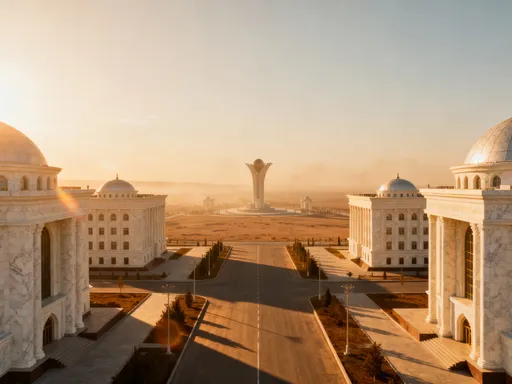
Arriving in Ashgabat from the arid Karakum Desert, the transition is nothing short of dramatic. One moment, you’re surrounded by endless beige sands and sparse vegetation; the next, a dazzling skyline of gleaming white structures rises from the horizon like a mirage made real. The city’s reputation as the 'City of White Marble' is not exaggeration—it is fact. According to official reports, over 540 buildings in central Ashgabat are clad in locally quarried white marble, giving the urban core a uniform, almost otherworldly appearance. This consistent use of marble is unparalleled in scale anywhere else in the world.
The first sight of this marble-clad metropolis often evokes awe, even disbelief. Visitors frequently describe an initial sense of disorientation, as if they’ve entered a film set rather than a living capital. The reflective surfaces catch the sunlight throughout the day, shifting in hue from cool silver at dawn to warm gold at sunset. In the midday heat, the glare can be intense, emphasizing both the brilliance and the boldness of the city’s architectural vision. It’s not merely about beauty—it’s a statement of identity, ambition, and resilience.
What deepens the emotional impact is the contrast between Ashgabat’s polished façades and its geographic isolation. Nestled against the Kopet Dag mountain range and bordering Iran, the city stands as an oasis of order in a region often associated with rugged terrain and ancient trade routes. The choice of marble, a material historically linked to empires and permanence, signals more than aesthetic preference. It reflects a deliberate effort to craft a modern national image rooted in dignity and endurance. For many travelers, this first encounter becomes a lasting impression—one of wonder, curiosity, and a growing appreciation for the story behind the stone.
Why Architecture Defines Ashgabat’s Identity
To understand Ashgabat’s architecture is to understand Turkmenistan’s journey as a nation. The city’s built environment is not merely functional—it is deeply symbolic, shaped by seismic upheaval, Soviet legacy, and post-independence renewal. The 1948 earthquake, which nearly destroyed the city and claimed tens of thousands of lives, marked a turning point. Rebuilt under Soviet planning principles, Ashgabat emerged with wide boulevards, standardized housing blocks, and a focus on utility. Yet today’s skyline tells a different story—one of reinvention and cultural reclamation.
Following independence in 1991, Ashgabat underwent a sweeping transformation guided by a national vision to express Turkmen identity through urban design. Architecture became a tool for nation-building, a way to visually assert sovereignty and pride. This period saw the launch of an ambitious construction campaign, with new government buildings, monuments, and public spaces designed to reflect both modernity and heritage. Traditional Turkmen patterns—such as those found in carpet motifs and jewelry—are subtly integrated into façades, gates, and interior details, creating a unique architectural language that is neither purely Western nor entirely traditional.
The result is a cityscape that communicates strength and continuity. While Soviet-era structures remain in some residential areas, the central districts have been completely reimagined. The architectural shift was not just aesthetic but ideological—moving from collective uniformity to national distinctiveness. Marble, once a luxury material, became a unifying element, symbolizing purity, stability, and permanence. Even the city’s layout, with its radial avenues and symmetrical plazas, echoes a sense of order and harmony that resonates with cultural values of balance and dignity.
What makes this transformation remarkable is its coherence. Unlike many capitals where development occurs haphazardly, Ashgabat’s evolution has followed a centralized, long-term plan. This top-down approach has allowed for consistency in design, material use, and scale. While some critics view this as overly controlled, others recognize it as a rare example of intentional urban identity formation. For the people of Turkmenistan, the city’s architecture stands as a testament to survival, self-determination, and the power of vision.
Monumental Landmarks That Dominate the Skyline
Ashgabat’s skyline is defined by a series of monumental structures that serve as both functional buildings and national symbols. Among the most iconic is the Arch of Neutrality, a towering tripod structure crowned with a rotating statue of former President Saparmurat Niyazov. Originally erected in the city center and later relocated to the southern outskirts, the arch stands over 75 meters tall and offers panoramic views of the city. Its design blends futuristic elements with symbolic meaning, representing Turkmenistan’s declared status as a permanently neutral country, recognized by the United Nations in 1995.
Equally striking is the Turkmenistan Tower, a 211-meter communications and observation tower that dominates the northern skyline. Resembling a sleek, modern minaret, the tower features a metallic lattice design inspired by traditional textile patterns. It houses broadcasting equipment, a restaurant, and an observation deck that provides one of the best vantage points for viewing the city’s marble expanse. The engineering behind such structures is particularly impressive given Ashgabat’s location in a seismically active zone. All major buildings are constructed to withstand earthquakes up to magnitude 9 on the Richter scale, incorporating advanced shock-absorbing technologies and reinforced foundations.
The Presidential Palace, situated within a vast ceremonial complex, exemplifies neoclassical grandeur on an extraordinary scale. With its grand colonnades, golden dome, and expansive marble courtyard, the palace is designed to inspire reverence and reflect national authority. While public access is limited, the surrounding grounds are open for viewing, and guided tours often include exterior walks that highlight architectural details such as hand-carved reliefs and gilded ornamentation. The building’s symmetry, proportion, and use of light and space follow classical principles, yet the sheer size and opulence elevate it beyond mere imitation.
These landmarks are not isolated attractions—they are interconnected elements of a larger urban narrative. Their placement along central avenues and within major squares ensures visibility and accessibility, reinforcing their role in public life. For visitors, walking among them offers more than photo opportunities; it provides a tangible sense of the nation’s priorities—stability, sovereignty, and cultural pride. Each structure, in its own way, tells a chapter of Turkmenistan’s story, written in stone, steel, and marble.
The Grandeur of Public Spaces and Government Buildings
At the heart of Ashgabat lies Garaşsyzlyk Square, a vast ceremonial plaza that serves as the city’s symbolic and architectural centerpiece. Spanning over 15 hectares, the square is framed by government ministries, cultural institutions, and monuments, all unified by a strict design code emphasizing symmetry, order, and elegance. The marble façades of surrounding buildings reflect sunlight evenly across the open space, creating a luminous atmosphere that changes with the time of day. Fountains, meticulously landscaped flowerbeds, and rows of flagpoles add movement and color, yet the overall impression is one of calm and precision.
What distinguishes Ashgabat’s public spaces is their dual function—serving both civic and ceremonial purposes. On national holidays, Garaşsyzlyk Square hosts military parades, cultural performances, and official gatherings. In everyday life, it functions as a place for quiet walks, family outings, and public events. Benches, shaded walkways, and clean pedestrian paths encourage leisurely exploration, while strict maintenance protocols ensure the area remains immaculate. There are no vending stalls, no graffiti, and no visual clutter—just open space, architectural harmony, and a sense of civic dignity.
Government buildings surrounding the square follow a consistent aesthetic: white marble exteriors, grand staircases, colonnaded entrances, and domed roofs often accented with gold. The Ministry of Foreign Affairs, for example, features a central dome inspired by Persian architecture, while the Ministry of Culture incorporates traditional Turkmen geometric patterns into its window grilles and interior mosaics. These details are not merely decorative—they are deliberate references to the nation’s cultural heritage, woven into the fabric of modern governance.
The absence of commercial signage and advertising further enhances the sense of order. Unlike many global capitals where corporate logos dominate public view, Ashgabat’s central districts prioritize state and cultural messaging. This contributes to a unique urban experience—one that feels more like a curated national showcase than a typical metropolis. For visitors, the effect is both refreshing and thought-provoking, inviting reflection on how public space can shape national identity and collective memory.
Unexpected Contrasts: Modernity Beside Quiet Residential Zones
Just beyond the polished core of Ashgabat, the city reveals a different character—one of quieter neighborhoods, tree-lined streets, and more modest architecture. While the central districts dazzle with marble and monuments, the residential areas offer a glimpse into daily life. Here, the contrast is striking: modern apartment complexes with pastel-colored façades and decorative balconies stand alongside older Soviet-era buildings with utilitarian concrete frames and small windows. This architectural duality reflects the city’s layered history and ongoing transformation.
In newer housing developments, design continues to emphasize aesthetics and order. Buildings often feature arched entrances, ornamental stucco work, and rooftop domes reminiscent of traditional Central Asian architecture. Some complexes include internal courtyards with fountains and seating areas, promoting community interaction. Units are typically spacious by regional standards, with large windows to maximize natural light. These neighborhoods, while less photographed, represent the lived reality of Ashgabat’s citizens—families raising children, neighbors greeting each other, and daily routines unfolding amidst grand surroundings.
What surprises many visitors is the presence of color and pattern in these less-publicized areas. While the city center adheres to a strict white marble palette, residential zones incorporate soft blues, creams, and terracottas, creating a warmer, more human-scale environment. Decorative tile work, wrought-iron railings, and potted plants add personal touches, revealing individual expression within a highly structured urban framework. Even in quieter districts, attention to detail remains evident—sidewalks are well-maintained, trees are regularly pruned, and public lighting is consistently functional.
This juxtaposition between monumental public spaces and intimate residential life invites deeper understanding of Ashgabat. The city is not just a stage for national symbolism—it is also a place where people live, work, and connect. For travelers, exploring these neighborhoods offers a more rounded perspective, balancing the awe of grand architecture with the warmth of everyday humanity. It reminds us that even in a city defined by scale and spectacle, life continues at a personal, human pace.
Behind the Facade: Sustainability and Urban Planning Challenges
While Ashgabat’s architecture is visually stunning, it also raises important questions about sustainability and urban resilience. The city faces extreme climatic conditions, with summer temperatures regularly exceeding 40°C (104°F) and intense solar radiation. Maintaining large, sealed buildings with extensive marble cladding demands significant energy for cooling, particularly in government and ceremonial structures with limited natural ventilation. Air conditioning systems operate year-round in many central buildings, contributing to high energy consumption.
Efforts to address these challenges include the use of double-glazed windows, reflective coatings on marble surfaces, and strategic shading elements in newer constructions. Some buildings incorporate passive cooling techniques, such as interior courtyards and thermal mass materials, to reduce reliance on mechanical systems. However, the overall urban layout—with wide, treeless boulevards and limited green space—can amplify the heat island effect. While parks and landscaped areas exist, they are concentrated in specific zones rather than evenly distributed throughout the city.
Transportation infrastructure reflects a vision of order and efficiency. Ashgabat’s streets are exceptionally wide, with multi-lane avenues designed to minimize congestion. Traffic is light by global standards, partly due to low private vehicle ownership and effective public transit. The city’s metro system, though small, is modern and clean, with stations featuring marble walls, chandeliers, and artistic murals. However, pedestrian connectivity between districts could be improved, as distances are vast and shaded walkways are not always continuous.
Urban planners continue to balance preservation with growth. New developments on the city’s outskirts aim to accommodate population expansion while maintaining architectural coherence. The challenge lies in integrating sustainable practices—such as renewable energy, water conservation, and green building standards—without compromising the city’s distinctive aesthetic. Ashgabat’s future will depend on its ability to evolve as a livable, resilient capital while honoring the vision that shaped its remarkable present.
What Travelers Should Know Before Visiting Ashgabat
Visiting Ashgabat requires careful planning, as Turkmenistan maintains strict entry regulations. Most foreign travelers need a visa, which is typically obtained through a letter of invitation arranged by a registered tour operator. Independent travel is not permitted—visitors must be accompanied by a licensed guide throughout their stay. This requirement ensures compliance with local laws and facilitates access to restricted sites, including many government buildings and monuments.
The best time to visit is during spring (April to early June) or autumn (September to October), when temperatures are milder and the sunlight enhances the marble’s natural glow. Summer visits are possible but can be uncomfortable due to extreme heat, while winter, though cooler, may limit outdoor exploration. Mornings and late afternoons offer the most favorable lighting for photography, with long shadows and soft contrasts highlighting architectural details.
For optimal sightseeing, a combination of walking and car travel is recommended. The central district is walkable in sections, especially around Garaşsyzlyk Square and the main government complex. However, due to the city’s vast scale, a vehicle is necessary to reach more distant sites like the relocated Arch of Neutrality or the Ashgabat Circus. Guided tours often include stops at key landmarks, cultural institutions, and residential showcases, providing a comprehensive overview of the city’s architectural diversity.
When photographing public spaces, visitors should exercise discretion, especially near military installations, government offices, and transportation hubs. While photography of most monuments and streetscapes is permitted, some areas may have restrictions. Always consult your guide before taking pictures. Dress modestly and respectfully, particularly when visiting official sites. Carrying water, sunscreen, and a hat is advisable due to the strong sun. With preparation and an open mind, a visit to Ashgabat can be a deeply rewarding experience—one that transcends postcard views and connects you to a nation’s enduring story.
Ashgabat’s architecture is more than marble and monumentality—it’s a narrative of resilience, identity, and aspiration written in stone and steel. While unconventional, its urban landscape offers a rare glimpse into a nation shaping its image through design. For travelers open to the unexpected, this city delivers not just sights, but stories etched into every façade. It challenges perceptions, invites reflection, and ultimately, leaves a lasting impression far beyond its desert borders.