You Gotta See These Iconic Hakone Landmarks—My Check-In Story
Hakone isn’t just about hot springs and mountain views—its landmark buildings add a whole new layer to the experience. I checked in with curiosity and left in awe, discovering how architecture here blends tradition, art, and nature. From modern museums shaped like sculptures to historic inns with centuries of soul, every structure tells a story. This is more than sightseeing—it’s stepping into a living cultural journey. Let me take you through the must-visit spots that made my trip unforgettable.
First Impressions: Arriving in Hakone and the Architecture That Caught My Eye
The moment the train pulls away from the urban sprawl of Tokyo and winds into the foothills of Hakone, a subtle shift occurs—not just in scenery, but in the rhythm of life. The architecture begins to tell a different story. Gone are the glass towers and neon-lit storefronts; in their place rise sloping tiled roofs, wooden latticework, and low-slung buildings that seem to bow respectfully to the surrounding forest and mountains. It’s as if the built environment has been designed not to dominate, but to harmonize. My first real encounter with Hakone’s architectural charm came at the reconstructed Hakone Checkpoint, a historical gatehouse that once controlled travel along the ancient Tokaido Road. The structure, built with heavy timber beams and traditional joinery, stands as both a reminder of the past and a welcome into a place where time moves differently.
Even the roadside rest areas in Hakone feel intentional. At one stop, I found myself drawn not to the snacks or souvenirs, but to the design of the wooden pavilion where travelers gather to sip green tea. The open-air seating, framed by carved eaves and stone pathways, invites lingering. There’s no rush here—just space to breathe, observe, and absorb. These small architectural gestures signal a deeper philosophy: that buildings should serve not only function but feeling. The angles of rooftops echo the nearby peaks; wooden shutters open like hands offering a view. Every detail, from the placement of a lantern to the curve of a garden wall, seems designed to guide the eye and calm the mind.
What struck me most was how these structures create a sense of arrival. In a world where travel often feels transactional—book a ticket, reach a destination, snap a photo—Hakone’s architecture insists on presence. It asks you to slow down, to notice the grain of the wood, the sound of wind through bamboo, the way light filters through a paper shoji screen. This isn’t just design for beauty’s sake; it’s design with intention, rooted in centuries of Japanese aesthetics that value simplicity, impermanence, and connection to nature. As I made my way deeper into the town, I realized I wasn’t just visiting a new place—I was being gently ushered into a different way of experiencing space and time.
The Open-Air Art Experience: Hakone Open-Air Museum as a Architectural Playground
If Hakone’s charm begins at the roadside, it truly unfolds at the Hakone Open-Air Museum, where art, nature, and architecture converge in a breathtaking dialogue. Unlike traditional museums confined within walls, this space invites visitors to wander through terraced hillsides, past bubbling streams, and around monumental sculptures that seem to grow from the earth itself. The museum’s layout is a masterclass in spatial storytelling—each turn reveals a new vista, a surprise, a moment of quiet reflection. Here, buildings are not separate from the landscape but woven into it, serving as both shelter and sculpture.
One of the most striking features is the Picasso Pavilion, a sleek, modernist structure that houses a permanent collection of the artist’s works. Nestled among maple and pine trees, the building’s clean lines and white exterior contrast beautifully with the organic surroundings, yet it never feels intrusive. Instead, it acts as a frame—drawing attention not to itself, but to the art within and the greenery beyond. The interior is softly lit, allowing the vibrant colors of Picasso’s ceramics and paintings to stand out without glare. What makes this space so powerful is its balance: it honors the artist’s legacy while respecting the tranquility of the site. Visitors move through it quietly, almost reverently, as if the architecture itself encourages a certain hush.
Outside, the museum’s design continues to impress. Pavilions with curved roofs offer shade near reflecting pools, where Henry Moore’s bronze figures seem to float on water. An open-air bathhouse, fed by natural hot springs, blends wellness with artistry—its wooden decks and stone walls making the act of soaking feel like part of the exhibit. Families relax on grassy slopes, children chase butterflies near abstract sculptures, and couples pause on stone benches to take in the view. The museum doesn’t just display art; it creates an environment where art is lived, where every step is an encounter with beauty. This is open-space design at its finest—thoughtful, accessible, and deeply human.
What sets the Open-Air Museum apart is its refusal to separate the visitor from the experience. There are no ropes, no ‘do not touch’ signs—just an invitation to engage. You can walk around, sit beside, even touch some of the works. The architecture supports this philosophy: wide pathways accommodate strollers and wheelchairs, rest areas are plentiful, and signage is subtle, often carved into stone or wood. It’s a place designed for lingering, for discovery, for the kind of slow exploration that stays with you long after you leave. In a world that often prioritizes speed and efficiency, the museum feels like a quiet rebellion—a space where time is not money, but a gift.
Modern Meets Mountain: The Design Philosophy Behind the Pola Museum of Art
Nestled deeper in the forested heart of Hakone, the Pola Museum of Art offers a different kind of architectural experience—one that disappears into the landscape. At first glance, you might miss it entirely. The museum is built largely underground, its roof covered in grass and wildflowers, blending seamlessly with the surrounding hills. This deliberate choice reflects a core principle of its design: to preserve the natural beauty of the area while housing a world-class collection of Impressionist and modern art. As I approached along a winding forest path, the only visible structures were low glass pavilions that seemed to float above the ground, their reflections shimmering in a nearby pond.
Stepping inside, I was struck by the quiet elegance of the interior. Natural light filters through skylights and glass walls, illuminating paintings by Monet, Renoir, and Picasso without the harshness of artificial bulbs. The galleries are arranged in a gentle spiral, guiding visitors downward in a way that feels intuitive, almost meditative. There are no crowded corridors or confusing layouts—just a calm, continuous flow that mirrors the rhythm of a walk through the woods. The use of wood, stone, and soft lighting creates a sense of warmth and intimacy, making even the most famous works feel personal, as if shared in confidence.
What makes the Pola Museum truly special is how it frames the outside world. Large windows at the end of each gallery offer carefully composed views of the forest and distant peaks. A painting of a garden is followed by a real garden just beyond the glass; a landscape on canvas is mirrored by the living landscape outside. This dialogue between art and nature is not accidental—it’s central to the museum’s philosophy. The architects understood that in Hakone, the view is part of the collection. By minimizing the building’s footprint and maximizing transparency, they’ve created a space where culture and environment are in constant conversation.
For visitors, the experience is both enriching and grounding. Parents point out colors to their children; older couples sit together on benches, speaking in hushed tones. There’s a sense of reverence, not just for the art, but for the space itself. The museum doesn’t shout its importance—it whispers it. And in doing so, it invites a deeper kind of attention, one that rewards patience and presence. In an age of digital overload and sensory bombardment, the Pola Museum stands as a quiet testament to the power of restraint, to the idea that sometimes, the most profound experiences come not from more, but from less.
Ryokan as Heritage Architecture: Staying in a Traditional Inn with Timeless Design
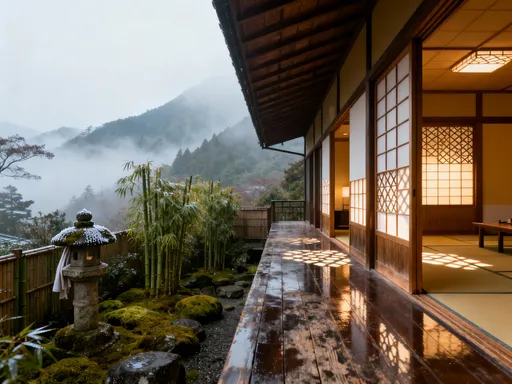
No visit to Hakone is complete without staying in a ryokan—a traditional Japanese inn where architecture and hospitality are inseparable. I chose a centuries-old establishment tucked into a quiet valley, its wooden gates marking the entrance to a world of stillness and care. From the moment I slipped off my shoes at the genkan, the design of the space began to shape my experience. Tatami-matted rooms with sliding paper doors opened onto engawa verandas that overlooked a koi pond and rock garden. Every element, from the low wooden tables to the futon beds laid out at dusk, felt intentional, designed not for grandeur, but for comfort rooted in tradition.
The ryokan’s architecture is a living record of Japanese craftsmanship. The beams are darkened with age, the wood polished smooth by generations of hands. Yet modern comforts are seamlessly integrated—underfloor heating keeps the rooms warm in winter, and private onsen baths offer a luxurious touch without disrupting the aesthetic. What’s remarkable is how these updates never feel intrusive. The inn hasn’t been modernized at the expense of its soul; instead, it has evolved with grace, honoring its past while meeting the needs of today’s travelers. Even the public bathhouse, shared by guests, maintains a sense of serenity, with high ceilings, stone walls, and soft lighting that make the ritual of bathing feel sacred.
Staying in a ryokan is more than a place to sleep—it’s an immersion in a way of life. Meals are served in the room, arranged like art on lacquered trays: delicate sashimi, miso soup, grilled fish, and pickled vegetables, each dish reflecting the season. The staff move quietly, bowing with genuine warmth, their presence felt but never intrusive. At night, lying on the futon beneath a soft quilt, I listened to the sound of a distant stream and the rustle of leaves. There were no TVs, no bright lights—just silence and the gentle rhythm of nature. In that stillness, I understood how architecture can shape not just space, but mood, memory, and meaning.
For modern travelers, especially those balancing family, work, and endless to-do lists, the ryokan offers something rare: a chance to reset. It’s a space designed not for productivity, but for presence. The low furniture encourages you to sit closer to the ground, to slow your breath, to notice the way light changes across the tatami. It’s a physical reminder that life doesn’t always have to be rushed, that beauty can be found in simplicity. In a world that often feels too loud and too fast, the ryokan stands as a sanctuary—a built expression of care, continuity, and calm.
Views from Above: The Role of Observation Decks and Cable Cars in Shaping Perspective
One of the most thrilling aspects of Hakone is the way it lets you see the world from new heights—and the architecture of its transit system plays a crucial role in that experience. The Hakone Ropeway, a series of cable cars that glide over valleys and steaming volcanic fields, is more than just transportation. It’s a moving observatory, designed to frame the landscape like a living painting. As the cabin rises above the treetops, the view opens up: emerald forests stretch into the distance, and on clear days, the perfect cone of Mount Fuji emerges in the horizon. The design of the cars—glass walls and ceilings—ensures that there’s no bad seat, no obstructed view. Even the timing of the ride feels intentional, with slow ascents and descents that allow time to absorb the scenery.
At Owakudani, the volcanic valley famous for its sulfurous fumes and black eggs, the observation decks are built to withstand the harsh environment while maximizing safety and accessibility. Wooden railings, stone pathways, and covered viewing areas protect visitors without blocking the view. Informational panels, written in multiple languages, explain the geology and history of the area, turning sightseeing into learning. What’s impressive is how the structures here don’t fight the terrain—they adapt to it. Platforms are elevated above unstable ground, walkways follow the natural contours of the land, and handrails are placed at just the right height for both children and adults. This attention to detail makes the experience inclusive, allowing families, seniors, and travelers with mobility aids to enjoy the same breathtaking panorama.
But beyond function, these observation points serve a deeper purpose: they create moments of awe. Standing on the deck, feeling the warm wind and smelling the faint tang of sulfur, you’re reminded of nature’s power and beauty. The architecture doesn’t compete with that—it enhances it. Framed openings direct your gaze toward Fuji; benches are placed where the view is most dramatic; even the sound of the ropeway cables adds to the atmosphere, a soft hum that feels almost musical. These are not just places to take photos; they’re places to feel small in the best way, to remember your place in a much larger world.
For many visitors, especially those from cities where horizons are blocked by buildings, the experience is transformative. Parents point excitedly to the mountain, children press their faces to the glass, couples stand in quiet wonder. The ropeway and its platforms do more than transport—they inspire. And in doing so, they prove that infrastructure can be poetic, that even a transit system can be designed with heart and vision.
Hidden in Plain Sight: Smaller Landmark Structures Worth Noticing
While the museums and hot springs draw the crowds, some of Hakone’s most memorable architectural moments are found in quieter places. The Hakone Shrine, nestled on the shores of Lake Ashi, is one such gem. Its iconic red torii gate stands half in water, swaying gently with the waves, marking the entrance to a sacred space. The path to the shrine winds through a forest of tall cryptomeria trees, their trunks wrapped in sacred rope, their branches forming a natural cathedral. The shrine buildings themselves are modest—wooden structures with curved roofs and simple lines—but their placement, their stillness, their harmony with the lake and sky, make them unforgettable.
Elsewhere, small wooden footbridges cross trickling streams, their railings worn smooth by time and touch. Tea houses with thatched roofs offer shelter and a cup of matcha, their interiors darkened by age, their tatami floors slightly uneven. These structures don’t announce themselves. They don’t have long lines or admission fees. But they are essential to Hakone’s character—the quiet notes that give the symphony its depth. They remind us that beauty isn’t always loud, that significance doesn’t require scale.
For the mindful traveler, these details are treasures. The way a lantern casts a soft glow at dusk, the pattern of rain on a stone courtyard, the curve of a roof that echoes the shape of a distant hill—these are the moments that stay with you. And they’re all the more powerful because they’re not staged for Instagram. They exist simply because they belong. Learning to see them requires slowing down, looking closely, and resisting the urge to always move to the next big attraction. But when you do, you discover that Hakone’s soul isn’t just in its landmarks—it’s in the spaces between them.
Why These Buildings Matter: The Bigger Picture of Culture, Tourism, and Preservation
The architecture of Hakone is more than a collection of beautiful buildings—it’s a reflection of values. It shows a culture that respects nature, honors tradition, and designs with intention. Each structure, whether a grand museum or a simple tea house, contributes to a sense of place that is increasingly rare in our globalized world. In an age where cities look more alike every year, Hakone stands as a reminder that identity can be built, quite literally, into the walls around us.
Yet this heritage is not frozen in time. Hakone has embraced tourism without sacrificing authenticity. The balance is delicate—new facilities are built with care, old ones restored with respect. The result is a destination that feels both accessible and authentic, modern and timeless. This is not accidental; it’s the product of thoughtful planning, community stewardship, and a deep understanding of what makes the region special.
For visitors, especially those seeking meaningful travel experiences, Hakone offers a model of how to engage with a place—not as a consumer, but as a participant. When you walk through a ryokan, stand on a viewing deck, or sip tea in a quiet garden, you’re not just observing culture; you’re living it. The architecture invites that participation, creating spaces where connection is possible—not just to the past, but to each other, and to the natural world.
As I left Hakone, I carried more than souvenirs and photos. I carried a deeper appreciation for how design shapes experience. The buildings here don’t just shelter—they teach. They remind us that beauty, tranquility, and meaning can be built into the world, one thoughtful stone, one curved roof, one quiet room at a time. And perhaps, they whisper a challenge: to bring that same care into our own lives, our own homes, our own ways of moving through the world.
Hakone’s landmark buildings are not just destinations. They are invitations—to slow down, to look closely, to feel deeply. They are stories built in wood, stone, and light. And for anyone willing to check in, not just with a reservation, but with their heart, they offer a journey that transforms the way we see not only a place, but ourselves.